Cliodynamics, Mathematics, Dynamical Systems and Complexity
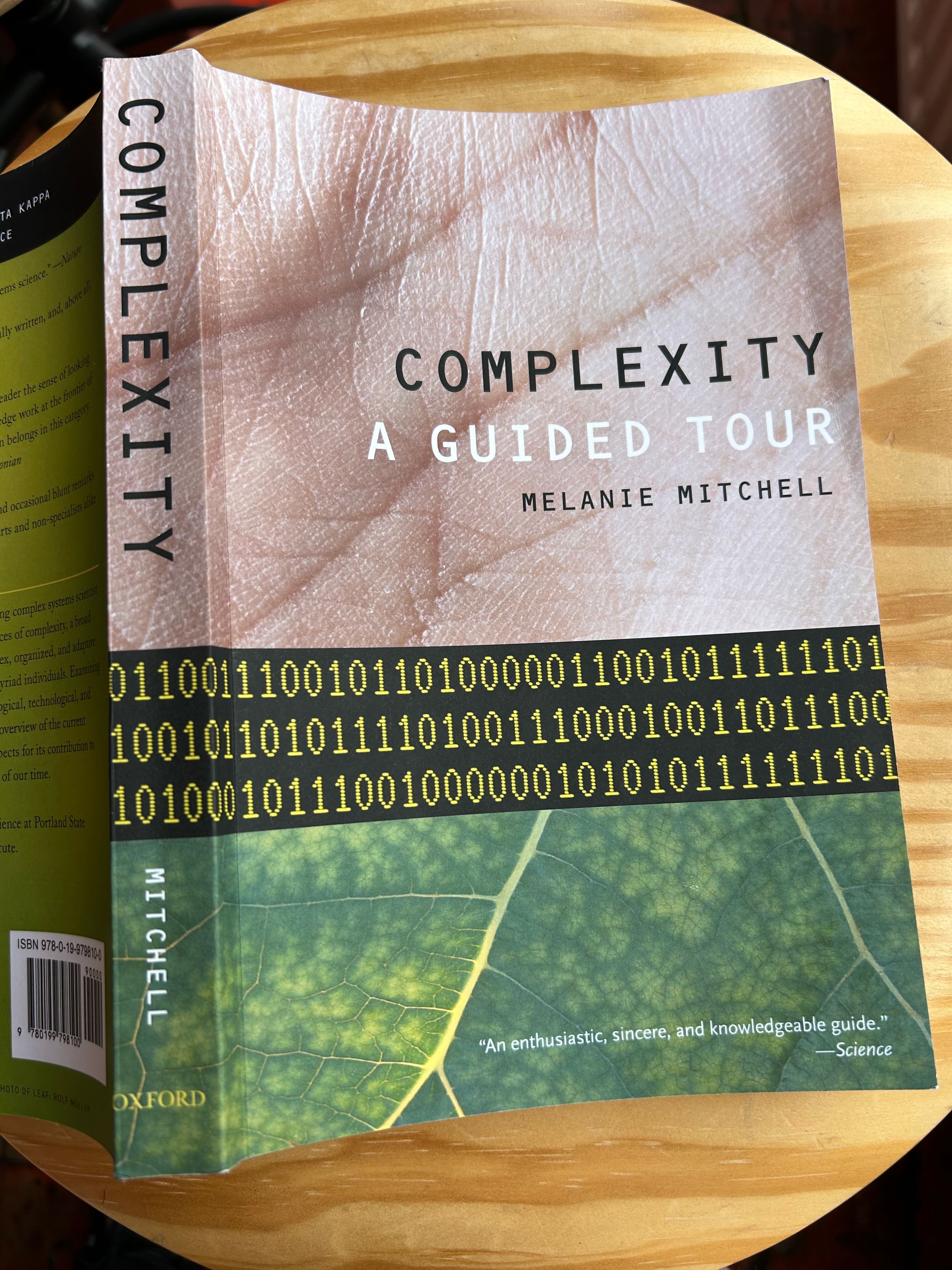
Complexity is the attractive thing for me. I can’t ignore or avoid it and lives rent free in my head. It started with the Foundation series by Asimov a good 3 decades ago. I read two books in the topic recently, and I have a better feeling what is that I’d like to do. The first one was the “War and Peace and War” by Peter Turchin and I just finished the Complexity: A Guided Tour by Melanie Mitchell.
The first one is about dynamics in history and some hints about how these dynamics can be described by mathematics. Here “described” means a decent effort and probably not a model but there is a book about this on my desk by Turchin. Doesn’t matter how good or bad quality the model is - I assume it is a decent one - someone did it. There is someone who took the first steps and wrote about it. The hardest part is done.
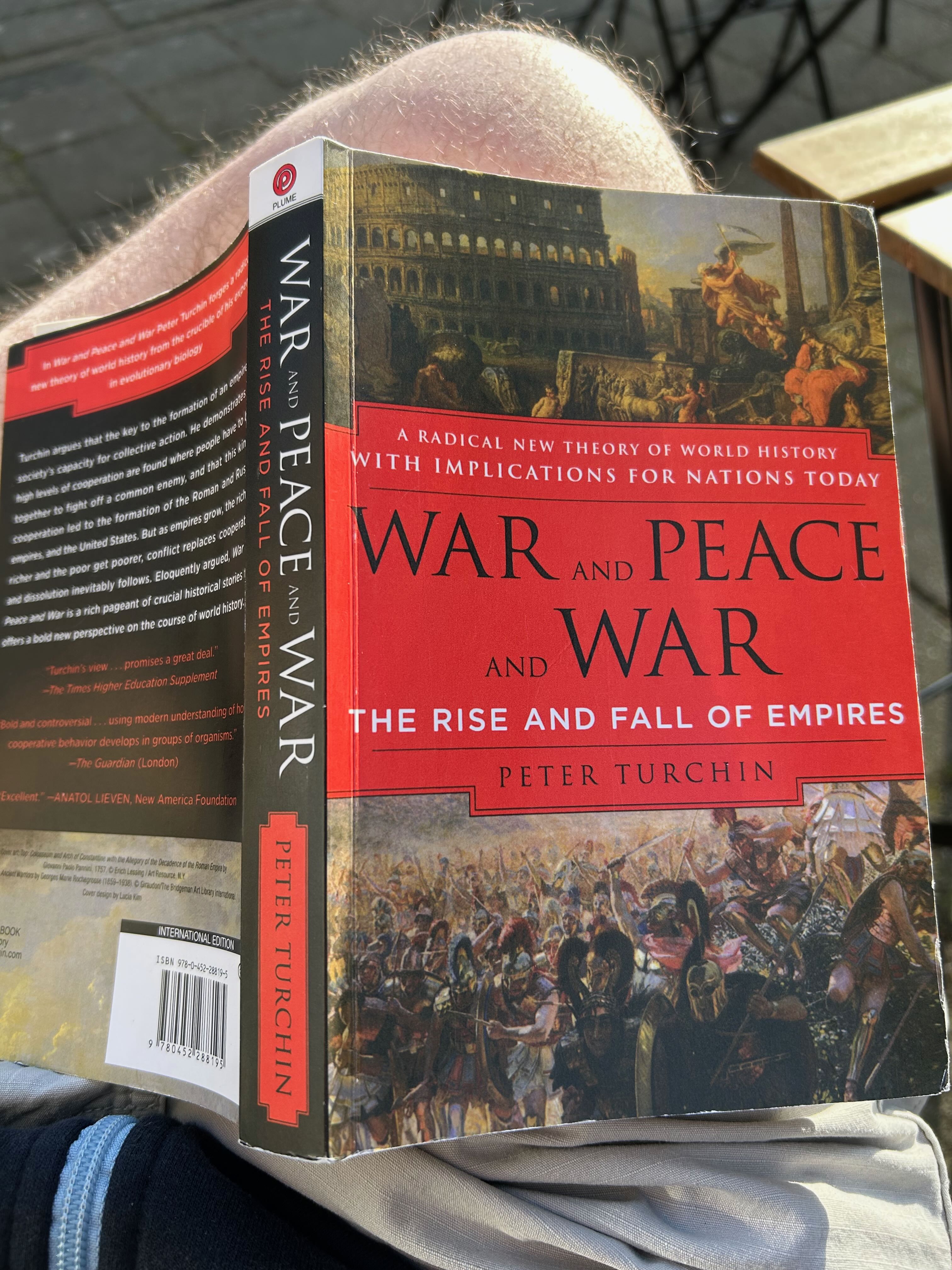
The guided tour gives an overview what complixity science looks like nowadays, the books was published in 2008. For me the most important thought in it was showing the dichotomy between reductionism and holism. Majority of engineering we know today is linear where superposition exist. It means that we can go down to the nitty-gritty details and find solutions. Even if these solutions are fully separated their sum is going to be a solution. This is the beauty of linear systems. But, complexity is non-linear. Superposition doesn’t hold in this realm. It requires a different approach which can be somewhere between hardcore reductionism and holism depending on the context. Beside this the book shows many things from the field and it is really interesting. And it shows the most important thing for me: hardcore mathematics skills are requried.
After reading the two books and knowing what are the topics I want to study in Aerospace Engineering there is a buzz in my head, but I feel a clear direction where I want to go. The hypersonics - astrodynamics - GNC triangle remains, but there is a slight shift in the application. From the aerospace application point of view I feel that adaptive systems, semi- or fully autonomous systems and swarm operations is the field. For example, imagine that there is a space telescope consisting of 10-100 small satellites where their formation flight formulates the mirror. This is a high precision semi- or fully autonomous operation. Every satellite has to keep their position, measure, do partial or full calculations and figure out what to do next to keep the mirror pieces in position to support the scientific mission. Beside the aerospace application I really want to go deep in how mass manipulation, rumour, impact of education on society and asabiya can be modelled.
After a few seconds you might see the common ground of the two problems: graphs, networks, propagation of computation results and decisions, handing out and/or gaining control and lead. These are a little bit abstract definitions but all of them can be identified in both fields. Both requries agent based modelling and hardcore mathematics skills. As for mathematics, I have to know all the engineering mathematics the field can offer in order to find the right mathematical approach to identify modelling solutions. This includes statistical mechanics, continuum mechanics, dynamical systems, complexity theory, graph theory and I would not be surprised if I should look into topology too. Not to mention the attached analysis topics to the mentioned fields.
I also have to mention that ABM includes some programming too. Since I can’t stand python I will use Rust for ABM modelling, and since I can’t really ignore the interesting nature of the programming part of ABM I started learning the relevant Rust topics like parallel processing, threading and lifetimes and all the nine-yards coming with high performance Rust.
What is the expected outcome here? - you might ask. As for aerospace engineering: I really want to contribute to the coming space industry and building systems I mentioned. These problems are extremely interesting and I am still a little boy who loves sci-fi. As for cliodynamics: there is still a strong buzz in my head, I feel stronger almost daily that my brain tries to say something but it doesn’t have the language to explain it. There is an urge to pick up the language - mathematics - andr express what I see. ABM is a tool to iteratively working out both the aerospace and the cliodynamics problems. The programming side brings an autonomy, an independence from tools and the ability to create the tools I need.
I think this portfolio is going to provide me enough intellectual challenges to live an interesting life.
All content is property of Andras Csanyi. AI tools are not allowed to use this content.